Lead generation connects marketing activity with people who may have a real need for your service. For a UAE business, that means attracting the right audience, recording permission and context, qualifying each enquiry and helping sales follow up. This guide explains the process without treating every form submission as a good lead.
What is lead generation?
Short answer: lead generation is the process of attracting potential customers and nurturing them through your funnel until they are ready to buy. It spans ads, SEO, content, email, social and calling. The goal is a steady flow of qualified leads, measured by cost per lead and conversion, not just volume.
Lead generation is the process of attracting potential customers and nurturing them through your funnel until they are ready to buy. Today, that means far more than capturing a form fill. It covers:
- Attracting strangers with valuable content, advertising, and discoverability.
- Converting visitors into identified prospects through opt-ins, forms, and conversations.
- Qualifying leads on fit, intent, and readiness to buy.
- Nurturing them with education and personalised communication.
- Scoring leads so sales focuses on the highest-value ones.
- Handing sales-ready leads over with full context, and re-engaging the ones who were not ready yet.
The types of leads you will meet: cold (no awareness yet), warm (some interest), and hot (clear buying intent), plus Marketing Qualified Leads (MQLs), Sales Qualified Leads (SQLs), and Product Qualified Leads (PQLs) who have tried your product. The lifecycle runs subscriber, lead, MQL, SQL, opportunity, customer, and finally advocate.
Buyers often research a company before they contact sales. They compare services, reviews, case studies and answers to practical questions. For Dubai businesses, lead generation therefore includes both demand capture and the information that helps a buyer decide to enquire.
The lead generation funnel
Effective lead generation follows a clear, repeatable funnel:
- Attract (top of funnel): turn strangers into visitors with SEO content, social media, paid ads, PR, referrals, events, and partnerships.
- Convert (middle of funnel): turn visitors into leads with lead magnets (guides, templates, checklists), webinars, free trials and consultations, quizzes and calculators, live chat, and WhatsApp opt-ins.
- Nurture: turn leads into qualified prospects with email sequences, retargeting, personalised content, case studies, and multi-channel touchpoints.
- Close (bottom of funnel): turn prospects into customers with consultations, demos, proposals, free audits, testimonials, and risk-reducing offers.
- Delight: turn customers into advocates with great onboarding, loyalty and referral programs, and customer success stories.
Understanding the full lifecycle, not just the initial capture, is what separates a strategic system from random tactics.
How to generate qualified leads
The goal is not more leads, but more qualified leads that match your ideal customer and have real intent. The strategies that work for Dubai businesses:
- SEO: organic search is one of the highest-quality sources because searchers actively want a solution. Target commercial-intent keywords, build pillar content, optimise for local UAE and Arabic searches.
- Content marketing: blogs, comprehensive guides, original research, case studies, and comparison content build trust before people are ready to buy.
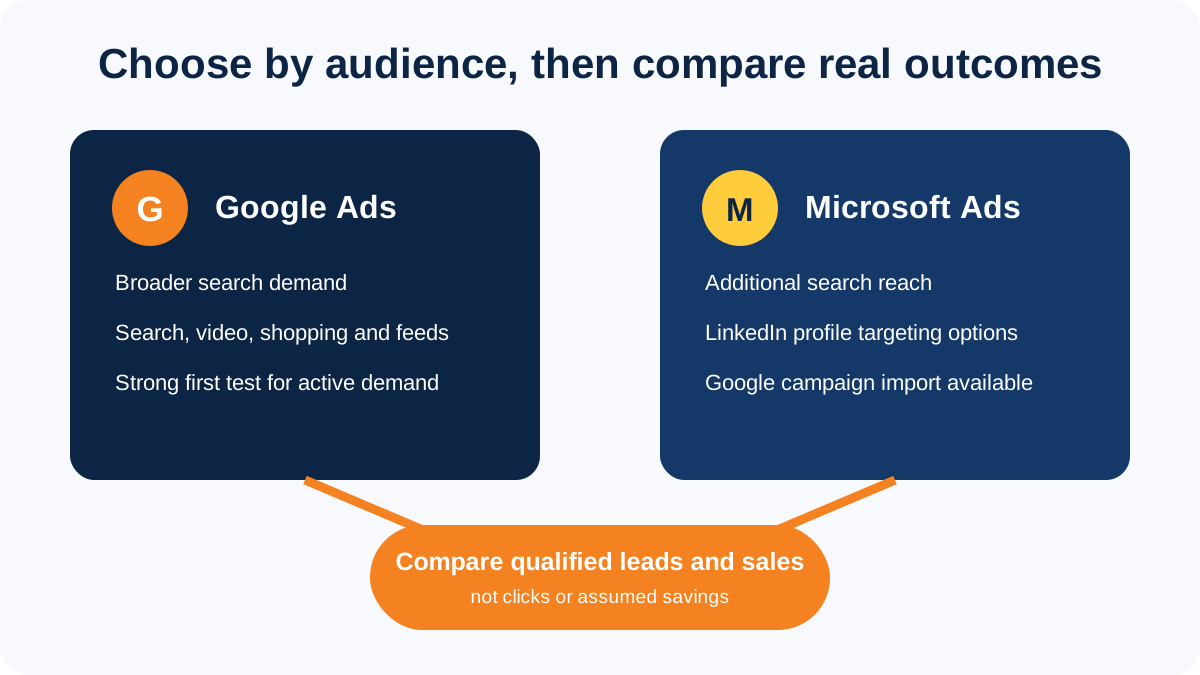
- Paid advertising: Google Ads for high intent, Meta for targeting and remarketing, LinkedIn for B2B, plus TikTok, Snapchat, and YouTube.
- Lead magnets: trade valuable content (ebooks, calculators, free audits) for contact details.
- Webinars and events: live interaction builds stronger relationships than static content.
- Referral programs: your existing customers are your best source of qualified leads.
- Account-based marketing (ABM): for high-value B2B, target specific accounts with personalised campaigns.
- Conversational marketing: live chat, AI chatbots, and WhatsApp Business, the UAE’s preferred channel, convert better than static forms.
- Social selling and PR: build authority on LinkedIn and earn credibility through media coverage.
The most successful Dubai businesses combine four to six of these into one integrated system. Phone-based outreach also works well, whether through a call centre for lead generation or automated calling.
Improve conversion at every stage
Generating leads is only half the job. Improving conversion across the funnel often delivers more growth than just driving more traffic:
- Visitor to lead: benefit-led headlines, a clear value proposition above the fold, short forms, social proof, fast loading, and multiple ways to convert (form, chat, phone, WhatsApp). A well-built landing page is central here.
- Lead to MQL: lead scoring, progressive profiling, segmentation, welcome sequences, and tracking intent signals like pricing-page visits.
- MQL to SQL: clear, agreed MQL and SQL definitions, scoring thresholds that trigger handoff, and full context for the sales team.
- SQL to customer: consultative selling, personalised demos, relevant proof, clear objection handling and follow-up matched to the buyer’s timeline.
- Customer to advocate: great onboarding, ongoing value, referral programs, and easy ways to leave reviews.
The compounding effect is real: a 10% lift at each of five funnel stages produces about 61% more customers from the same traffic.
Common lead generation mistakes to avoid
- Chasing quantity over quality, so sales wastes time on unqualified leads.
- Treating all leads the same instead of segmenting and scoring.
- Misaligned marketing and sales teams with no shared definitions.
- Neglecting nurture, when most leads are not ready to buy immediately.
- Over-relying on a single channel, which is risky when platforms change.
- Slow or poorly routed follow-up that reaches the prospect after their interest has cooled.
- Generic, impersonal outreach instead of signal-based personalisation.
- Ignoring mobile even when your own analytics show that most enquiries begin on a phone.
- Buying bad lead lists, which hurt your reputation and may breach UAE anti-spam law.
- Forgetting existing customers, your best source of referrals.
Lead generation trends to watch
- AI personalisation at scale across emails, landing pages, and chat.
- Privacy-first lead generation built on first-party, consented data.
- Conversational marketing through WhatsApp, DMs, and chatbots replacing static forms.
- Intent data and buyer signals enabling proactive outreach.
- Account-based everything (ABX) for B2B.
- Video and live engagement, community-led growth, and predictive lead scoring.
- Zero-click strategies as AI search answers reduce website visits.
Build a system, not just campaigns
The businesses that win do not rely on heroic one-off campaigns. They build a system: a clear ideal-customer profile, a mapped buyer journey, agreed lead definitions and SLAs between marketing and sales, an integrated tech stack (CRM, automation, analytics), and continuous A/B testing. That infrastructure compounds in a way scattered tactics never can.
Want a lead generation engine built for your business? We help UAE companies attract, qualify, and convert. Start by understanding your numbers with our guide to calculating cost per lead, or call +971 50 304 7470.