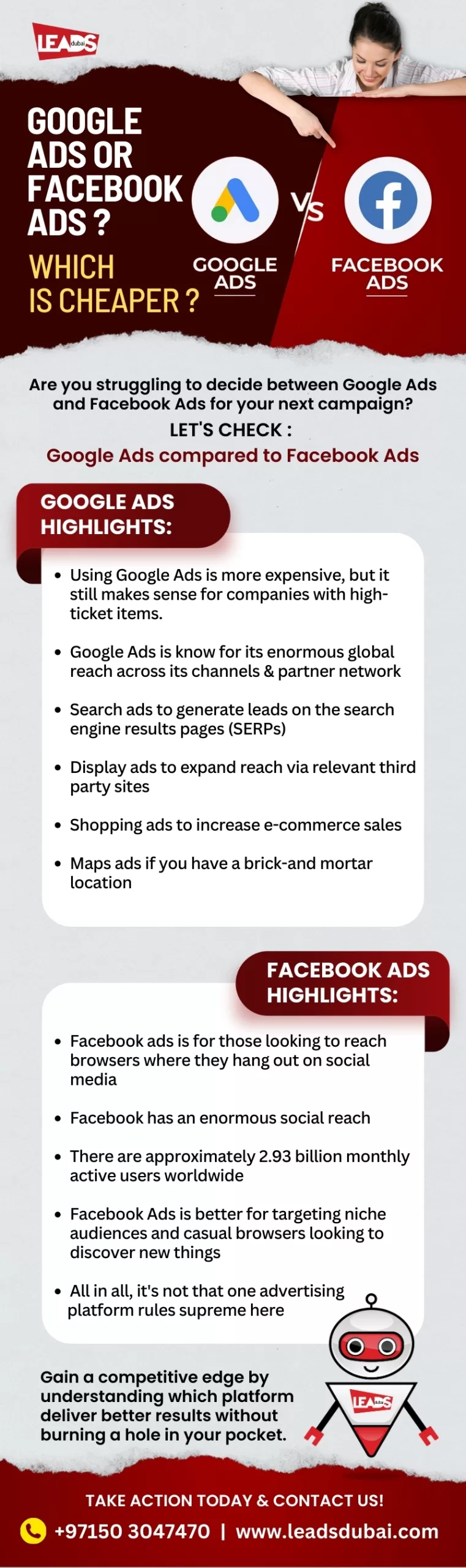
Short answer: Facebook Ads often buys cheaper reach and clicks, while Google Search usually reaches people with clearer buying intent. Neither platform is automatically cheaper for a business. Compare the cost of a qualified enquiry or sale, not CPC alone, and use the same sales definition when judging both platforms.
Published cost benchmarks are useful for planning, but they are not a quotation. Auction prices change by country, audience, industry, season, creative and conversion goal. A UAE property campaign cannot be judged against a global retail average.
| Metric | Google Ads | Facebook Ads |
|---|---|---|
| User mindset | Often searching for an answer or supplier | Usually browsing content and discovering options |
| Common buying metric | Cost per click or conversion | Cost per impression, click, lead or conversion |
| Budget pressure | High when valuable keywords attract many bidders | High when audiences are narrow or creative becomes tired |
| Best for | High-intent search & B2B | Awareness, discovery & e-commerce |
| Optimization tooling | Performance Max (AI) | Advantage+ (machine learning) |
Verdict: Choose the platform that can produce the right business result. Search is often stronger for existing demand, while Facebook and Instagram are useful for discovery and visual offers.
Google Ads vs Facebook Ads: cost overview
Google and Meta run auctions, so there is no permanent rate card. Google Search commonly charges for clicks and matches ads to searches. Meta can optimise delivery toward reach, traffic, leads, messages or sales across Facebook and Instagram. The cheapest click can still be expensive if the person never becomes a customer.
For lead generation, compare qualified leads, sales opportunities and revenue. For online sales, compare contribution after advertising costs. For awareness, compare reach, completed video views and brand-search growth. Use one measurement window and remove spam or duplicate leads before comparing campaigns.
When to choose Google Ads
Google Search is usually the clearer starting point when people already search for the service, product or problem. It suits urgent services, considered B2B purchases and products with known demand. Competition can make clicks expensive, so separate commercial searches from research and measure which enquiries sales accepts.
Performance Max and Shopping campaigns can reach customers across more Google inventory. They require reliable conversion data and suitable creative assets. Automation does not repair weak tracking or an unclear offer.
When to choose Facebook Ads
Facebook and Instagram ads are useful when the audience can be identified before they search. Strong demonstrations, customer problems, events and visual products can create demand in the feed. Campaign performance depends heavily on the offer and creative, so plan several clear variations and replace them when response falls.
Broad delivery may find more people than a tightly restricted audience, but lead quality must be checked in the CRM. A low instant-form cost is not a win if the contacts cannot be reached or do not meet the qualification criteria.
Running both platforms together
The platforms can support different stages of the same decision. Facebook and Instagram can introduce the offer, while Google Search ads can capture later searches. Remarketing can help people return, provided audience use and consent comply with applicable rules.
Do not add the two dashboards together and call every conversion unique. Use analytics and CRM records to identify duplicate leads, assisted visits and the channel that produced the qualified opportunity.
Budget recommendations
Set the test budget from the expected cost of a qualified result, not a universal minimum. A useful test needs enough money and time to generate several comparable outcomes without risking an amount the business cannot afford to learn from.
Before launch, agree on the conversion, qualification rules, sales follow-up time and stopping conditions. If reliable historical data does not exist, begin with a controlled test and review search terms, lead quality and creative response during the campaign.
Average costs per industry
Your own account is the most useful benchmark. Break results down by campaign, location, device, search theme, audience, creative and final lead status. A higher CPC may be acceptable when it produces qualified opportunities. A cheap campaign deserves less budget when sales rejects most of its leads.
 As a Google Ads partner agency in Dubai, UAE, we help businesses make
data-driven decisions about their advertising spend across both Google and
Facebook platforms.
As a Google Ads partner agency in Dubai, UAE, we help businesses make
data-driven decisions about their advertising spend across both Google and
Facebook platforms.
FAQs
Facebook Ads often produces cheaper reach and clicks, while Google Search often reaches people with stronger immediate intent. The cheaper platform is the one that produces an acceptable qualified lead or sale for your business. Auction costs vary by market, audience, industry, season and offer.
Google Search is often stronger when customers already search for the service. Facebook and Instagram can work well for visual offers, discovery and reaching a defined audience before they search. Compare qualified leads, sales and revenue using the same rules rather than comparing platform-reported clicks alone.
There is no reliable universal minimum. Work backward from the expected cost of a qualified result and choose a controlled test budget that can generate several comparable outcomes. Agree on the conversion, lead-quality rules and stopping conditions before launch.
Yes. Facebook and Instagram can introduce an offer while Google captures later searches. Use analytics and CRM records to identify assisted visits and duplicate leads, because each advertising platform may claim credit for the same customer journey.
Compare valid enquiries, qualified opportunities, sales, revenue and customer value. Remove spam and duplicate leads first. A platform with a higher CPC can still be more profitable when a larger share of its enquiries becomes customers.