Facebook advertising strategy for Dubai businesses
Short answer: a Facebook advertising strategy decides the objective, the funnel, the targeting and the testing plan before any money is spent. Meta reaches roughly 9.7 million people in the UAE, so reach is rarely the constraint. Choosing the wrong objective, and interfering during the learning phase, is what wastes the budget.
A Facebook advertising strategy is the plan that decides what you promote, to whom, with what budget, and how you measure results. Meta (Facebook, Instagram, Messenger and WhatsApp) reaches almost every adult in the UAE, so the platform is rarely the problem. Weak strategy is. Two things sit underneath any paid plan and are worth reading first: how the Facebook post algorithm decides who sees you organically, and how a Facebook Messenger chatbot handles the enquiries your ads generate. Get the objective, the funnel, the targeting and the testing right, and the same budget produces far more leads.
How big is that audience? Meta’s own advertising tools report 9.70 million people reachable on Facebook in the UAE, about 85 percent of the population, plus 8.05 million on Instagram (DataReportal, Digital 2026). Almost every customer you want is already inside Meta. What decides your result is what you put in front of them, and who you point it at.
Here is the strategy we use for clients, in the order it matters.
1. Start with the right objective
Everything follows from the campaign objective, because it tells Meta what to optimise for. Choose it to match your real goal:
- Sales for online or offline purchases.
- Leads for form fills, enquiries and quote requests.
- Traffic to drive clicks to your site, app or Messenger.
- Engagement for messages, calls and post interaction.
- Awareness only when reach is the genuine goal.
The most common and expensive mistake is choosing Awareness or Engagement when you actually want leads or sales. That points the algorithm at cheap likes instead of buyers.
2. Build a full-funnel plan
Few people buy the first time they see you. A strategy that only retargets runs out of audience, and one that only prospects never closes. Run all three stages together:
- Top of funnel (cold): reach new people with broad targeting and strong creative to introduce your brand.
- Middle (warm): retarget video viewers, page and profile engagers, and people who visited but did not act.
- Bottom (hot): retarget website visitors, add-to-carts and past customers with a clear offer.
3. Target smart, then let the algorithm work
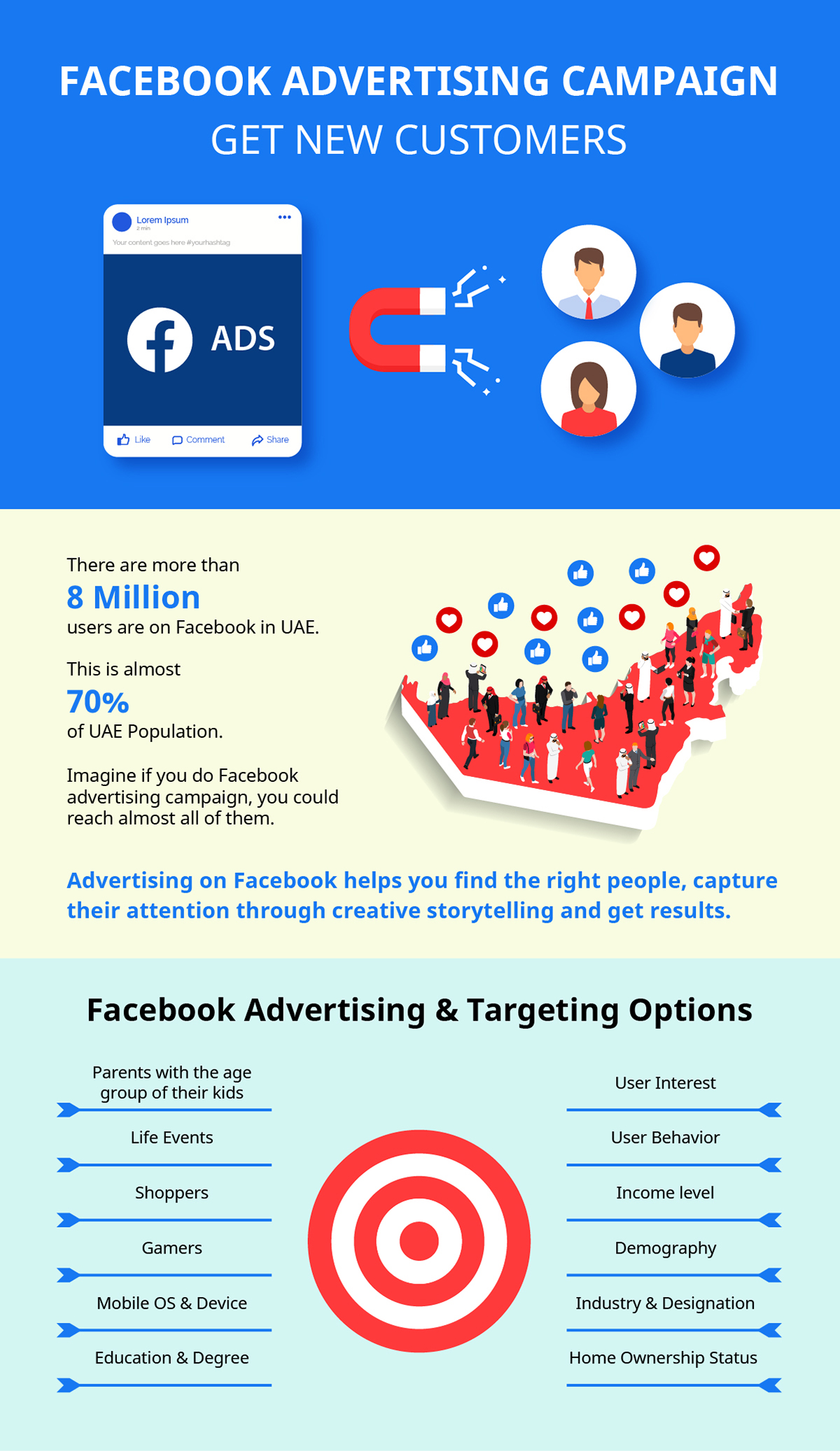
Meta targeting is still the most powerful in digital advertising: location down to a Dubai neighbourhood, demographics, interests, behaviours, plus custom and lookalike audiences built from your own data. The shift worth knowing: for cold prospecting, broad targeting with a strong creative now usually beats very narrow targeting, because Meta AI finds buyers better than manual filters. Keep tight, specific audiences for retargeting and lookalikes, where precision pays.
Just how granular can it get? You can target parents by the age of their kids, recent life events, homeowners, income level, education level, job title and industry, frequent shoppers, gamers, and device or operating system, among many others. For the full breakdown, see Facebook targeting options.
For the mechanics of how the auction picks a winner, see how the Facebook ad auction works.
4. Let the creative do the heavy lifting
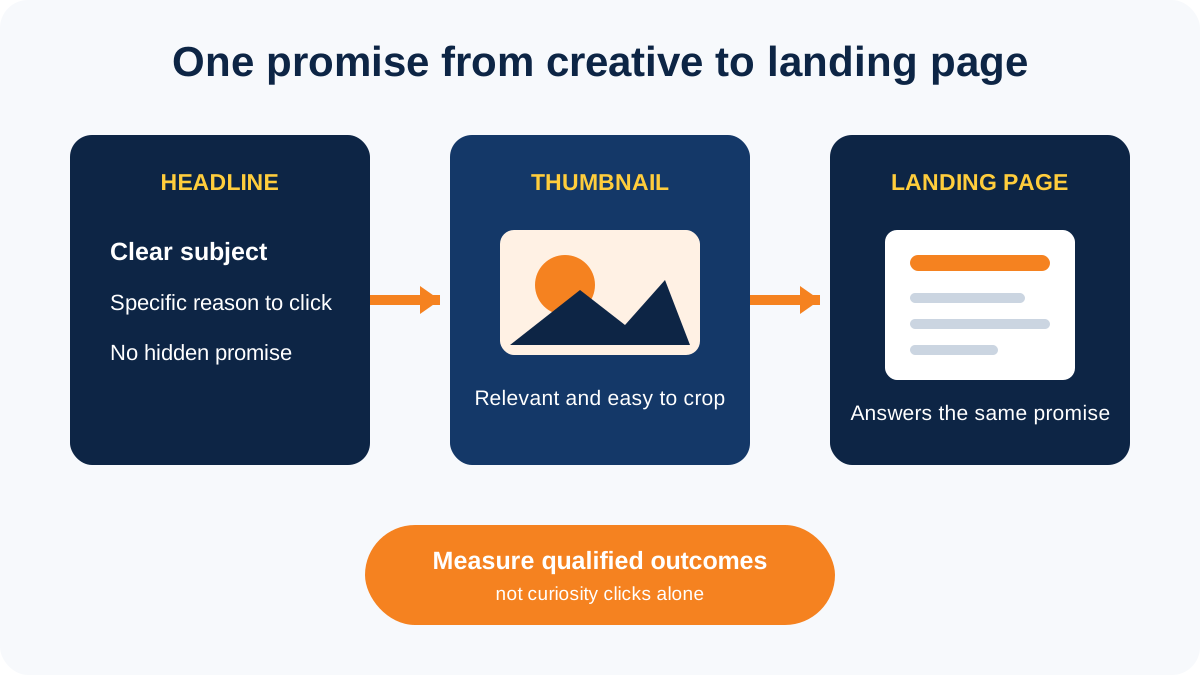
Targeting gets your ad in the room; creative decides whether it works. Lead with the benefit in the first line, use video and Reels (Meta favours them), keep text on images light, and match the ad to a fast, relevant landing page. Run three to five creatives per ad set and let the data pick the winner.
5. Respect the learning phase, then test
Every new ad set enters a learning phase while Meta works out how to deliver it, usually until it gathers around 50 conversions. Performance is unstable and the cost per result is higher during this window. That is normal. Do not panic-edit, because the wrong change here quietly wastes a lot of budget.
Only a significant edit restarts the learning phase. That means changing the targeting, the creative or the optimisation event, adding a new ad, pausing the ad set for 7 days or more, or switching the bid strategy. Small budget tweaks usually do not restart it, but big ones can. So once an ad set is learning, leave it alone and let it finish.
If 7 days pass and the ad set still has not settled, Meta marks it “Learning Limited”. That almost always comes down to one of these:
- The bid or cost control is too low. Raise it.
- The budget is too low to reach about 50 conversions a week. Raise it.
- The audience is too small. Widen it.
- You have too many ad sets splitting the data. Combine them.
- Your own ad sets overlap and compete in the auction. Merge them.
- The optimisation event is too rare. Optimise for an earlier event, for example add-to-cart instead of purchase if you get fewer than 50 purchases a week.
Give it a full week, judge those first days on delivery rather than cost per lead, then test one variable at a time.
6. Keep your campaign structure simple
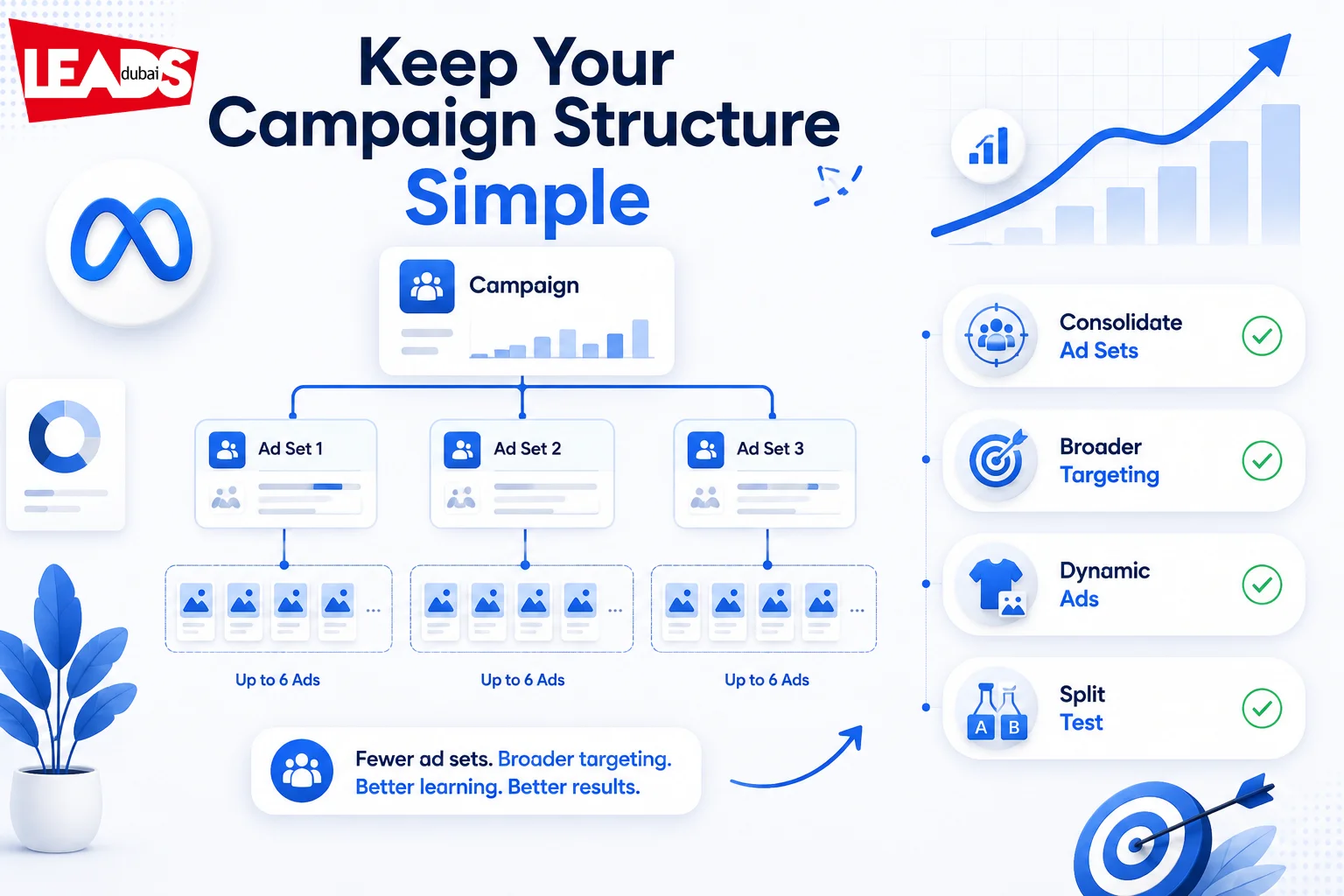
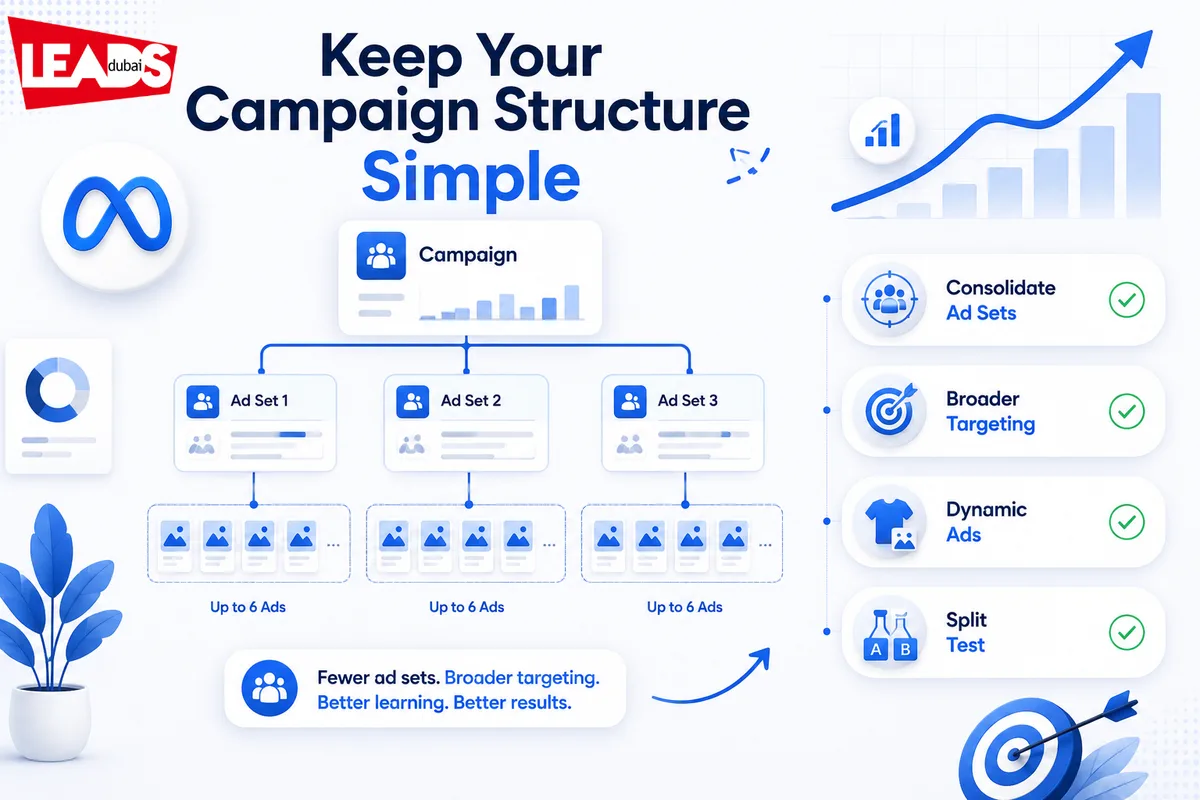
Fragmented accounts are one of the most common reasons ads underdeliver. Build too many ad sets, or cram too many ads into one, and none of them gather enough data to learn. Keep the structure tight:
- Consolidate ad sets. Fewer ad sets with broader targeting pool their learnings and let Meta optimise better.
- Keep it to around six ads per ad set. Past that, each ad gets fewer chances to prove itself. Use dynamic creative to test many variations efficiently.
- Pause ads that consistently get no delivery, so budget flows to the ones that work.
- Avoid audience overlap. When your own ad sets chase the same people, they bid against each other and the weaker one is throttled.
- Selling many products to one audience? Use dynamic ads instead of building a separate ad set for each product.
- Testing targeting or creative? Use split tests, so overlapping audiences do not bias the result.
One myth worth retiring: Meta dropped the 20 percent text rule in 2020, so an image is no longer rejected or throttled for carrying too much text. Keeping on-image text light is still worth doing because those creatives tend to perform better, but it is a recommendation now, not a delivery rule.
7. Use offers and UAE moments
Offer ads promote a discount or deal with a saved reminder and tracked redemption. Facebook nudges people when they first save the offer and again just before it expires, and you can run it online only, in store only, or both. A clear discount (20 percent or more), a real expiry and simple redemption lift response.
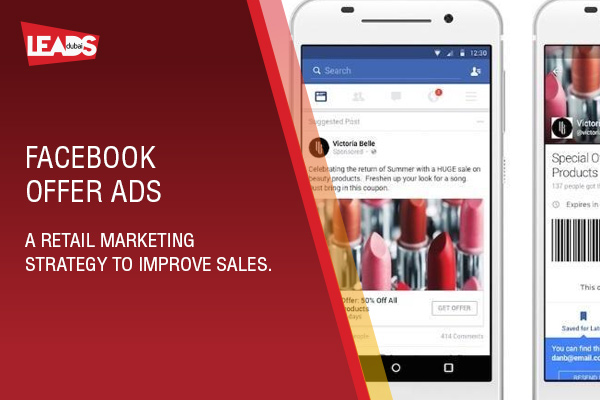
The offer types that tend to work best:
- Percentage discounts and buy-one-get-one deals
- Free-shipping thresholds and bundle deals
- Limited-edition drops and first-time-customer offers
Time promotions around UAE moments like Ramadan, Eid, Dubai Shopping Festival and National Day, when intent and spending are high.
8. Measure what matters and scale
Track cost per lead and cost per sale, not likes. Install the Meta Pixel and Conversions API so you can see which ads produce real results, and feed that data back to the algorithm. When something works, scale gradually, raising budget 20 to 30 percent every few days so you do not reset the learning, and expand by testing new audiences and creatives rather than only adding budget. If results stall, start with our checklist for Facebook ads that are not working.

Facebook ad formats at a glance
Once the strategy is set, pick the format that fits the job:
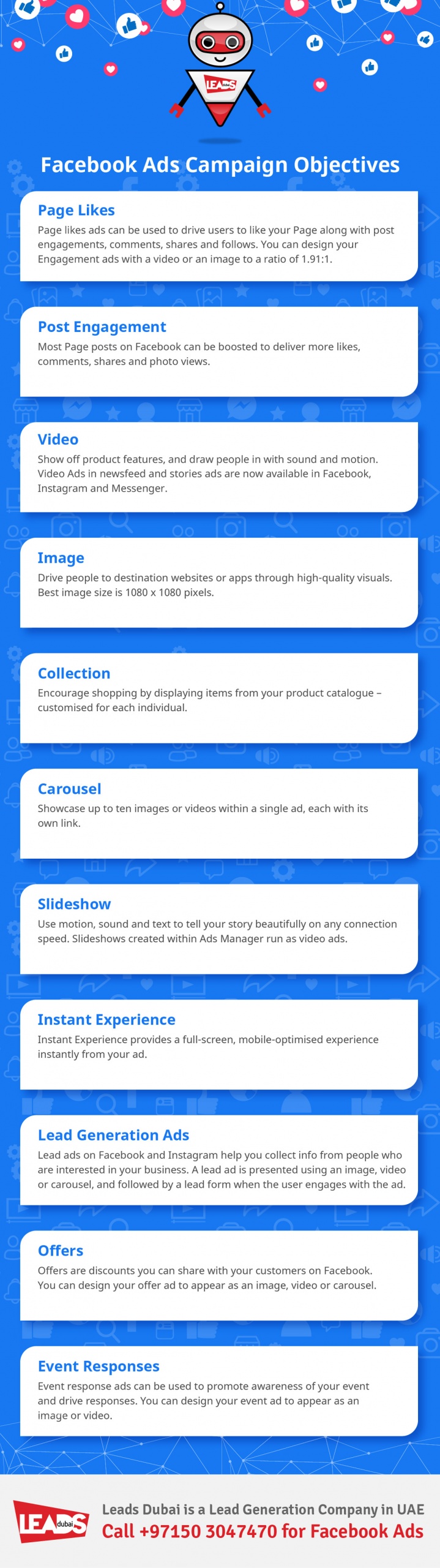
- Image: a single strong visual to send people to your site or app. Best at 1080 x 1080 pixels.
- Video: a product in motion with sound, running in feeds and Stories across Facebook, Instagram and Messenger. Meta favours it.
- Carousel: up to ten images or videos in one ad, each with its own link. Good for a range of products or steps.
- Collection: a shopping layout pulled from your catalogue and tailored to each viewer.
- Slideshow: a lightweight video built from images in Ads Manager, useful on slow connections.
- Instant Experience: a full-screen mobile page that opens straight from the ad.
- Lead generation ads: an image, video or carousel followed by a form the person fills in without leaving Facebook.
- Offers: a discount people can save and redeem, which works well around UAE moments.
- Event responses: promote an event and collect RSVPs.
Boosted plays like Page likes and post engagement have their place for warming an audience, but for leads and sales run proper campaigns in Ads Manager.
Want a Facebook advertising strategy built for your business and budget? See our Facebook advertising services or contact Leads Dubai for a plan.