Facebook ad auction explained. See how Facebook shows your ads

Facebook ad auction formula helps show your ads to a user based on many factors. Through this blog, we are trying to explain how to get your ads to be shown to more people in a cost-effective way.
When Facebook shows ads it tries to balance two things:
- Creating value for advertisers by helping them reach and get results from people in their target audiences.
- Providing positive, relevant experiences for people who use Facebook Products.
The Facebook ad auction balance
To achieve this balance, Facebook holds an auction to match the right ad to the right person at the right time. That way, advertisers reach people receptive to their ads, while people see something that interests them. All ads on Facebook compete against each other, and our system selects the ad that creates the most total value as the winner.
Generally speaking, the more relevant the system predicts an ad will be to someone, the less it should cost the advertiser to show it to them.
The Facebook ads learning phase
Each time one of your ads appears after winning in the auction, the delivery system learns more about the best people to target, times of day to show the ad, and placements and creatives to use. The more an ad appears, the better the delivery system optimizes the ad’s performance.
The learning phase is when the delivery system hasn’t learned enough for performance to stabilize. It occurs when you create a new ad set or make a significant edit to an existing ad or ad set. Ad sets exit the learning phase when their performance stabilizes.
In Facebook Ads Manager, the Delivery column reads Learning during the learning phase. Ad sets usually exit the learning phase after they receive approximately 50 results within 7 days. A smaller share of the budget spent in the learning phase typically results in a higher share of the budget spent on stable performance and a lower cost per result. For this reason, we recommend that you set up each ad set to get 50 results in 7 days.

Facebook ad auction formula
The formula that determines the winning ad in an auction is written as:
[Advertiser Bid] x [Estimated Action Rates] + [User Value] = Total ValueFacebook ad auction ranks each eligible ad by its Total Value, and the ad with the highest Total Value wins. They include the bid you submitted when you set up your ad, our predictions about how the people in your audience will react to your ad and how relevant we think they’ll find your ad.
Estimated action ratesEach ad has an optimization event, often an action you want a person to take, such as clicking to a website or installing an app. Estimated action rates represent how likely we think someone is to take that action.
We base our estimates on the person’s previous actions and your ad’s historical performance data. This helps us deliver your ads to the people most likely to give you the result you care about. Regardless of which action you choose to optimize for, we convert all advertiser values to an estimated CPM (eCPM) to allow us to rank ads with different optimization goals and bids.
Facebook advertising auctions also depend on the ad objective or the ad creative which performs the Facebook ad auction algorithm differently. If your ads are not shown to more people during 1 - 2 days, chances are it won’t show and it needs to be changed.
How to win more Facebook ad auctions
You rarely win by simply bidding more. Because the winner is the ad with the highest total value, the cheapest way to win is to raise your estimated action rate and relevance:
- Improve ad quality and relevance. Check the three Ad Relevance Diagnostics in Ads Manager: Quality Ranking, Engagement Rate Ranking and Conversion Rate Ranking. Ads rated above average across all three usually win more impressions at a lower cost.
- Match the creative to the audience. Strong, native-looking creative earns higher predicted engagement, which lifts total value without raising your bid.
- Pick the right optimisation event. Optimise for the action you actually want (leads or purchases), so Meta bids for the people likely to take it.
- Give it data. Let the ad set gather about 50 results a week and avoid frequent edits, so estimated action rates become accurate.
- Use the right bid strategy. Start with lowest-cost (automatic) bidding, then move to cost cap or bid cap once you know your target cost per result.
Meta AI, through Advantage+ campaigns and placements, increasingly handles bidding and delivery for you, but the same logic holds: relevance and a clear optimisation goal beat a bigger bid.
As a digital marketing company in UAE, we manage social media marketing campaigns for our clients and advise them on the best practices which can help get better marketing results. Are you facing issues with your social media advertising?
FAQs
Facebook’s ad auction matches the right ad to the right person at the right time. Each eligible ad is scored using the formula: Advertiser Bid x Estimated Action Rates + User Value = Total Value. The ad with the highest Total Value wins the auction, not necessarily the highest bidder.
Facebook’s auction considers three factors: your bid, estimated action rates (how likely users are to engage), and user value (ad relevance). A lower bid with higher relevance and engagement predictions can beat a higher bid with poor relevance. This system rewards advertisers who create quality, relevant ads.
The learning phase occurs when Facebook’s delivery system hasn’t gathered enough data to optimize your ad’s performance. Ad sets typically exit the learning phase after receiving approximately 50 results within 7 days. During this phase, costs may be higher and performance less stable. Avoid making significant edits during this period.
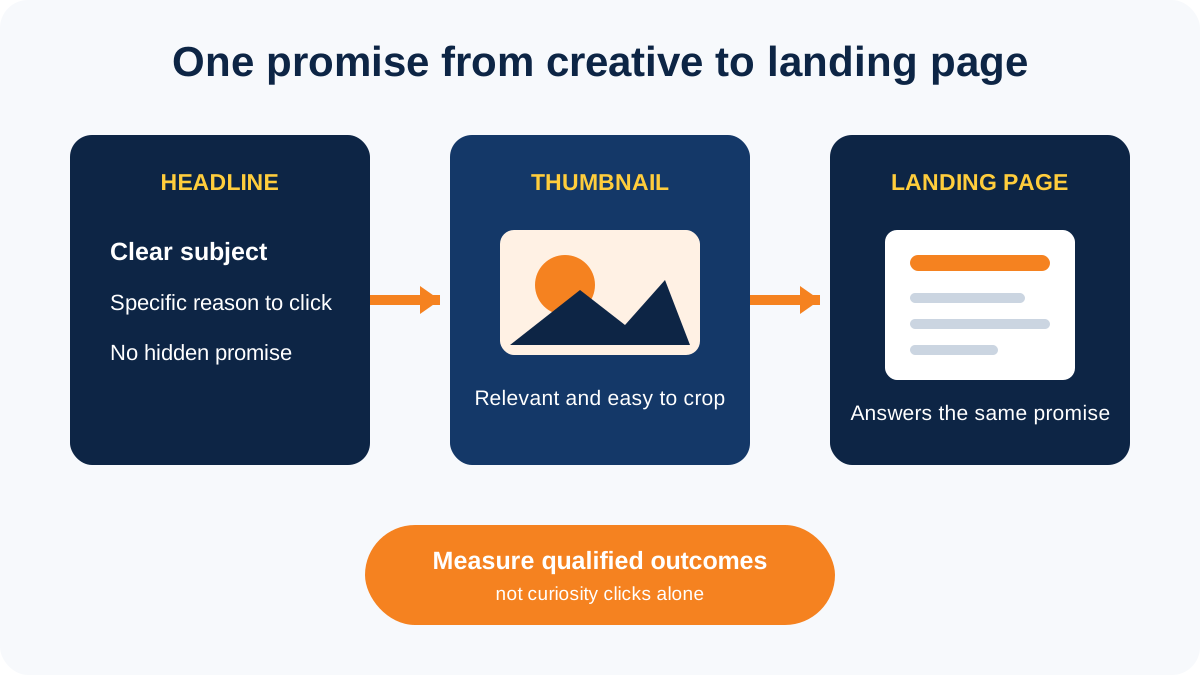
Improve relevance by creating highly targeted audiences, using engaging visuals and copy that resonates with your audience, testing multiple ad creatives, and ensuring your landing page matches the ad promise. Higher relevance scores lead to lower costs and better delivery in the auction.
For most advertisers, automatic bidding (lowest cost) works well as Facebook optimizes delivery for the best results within your budget. Use cost cap bidding when you need to control cost per result. Bid cap is ideal when you know your maximum acceptable cost per action. Start with automatic bidding and adjust as you gather performance data.