Advanced digital marketing is not about running every channel. It means giving each channel a job, measuring the commercial result and improving the whole customer journey. This guide gives UAE businesses a practical way to do that.
How digital is transforming business in the UAE
Short answer: advanced digital marketing combines the channels that compound: SEO and content for long-term traffic, paid search and social for immediate leads, email and remarketing to convert, and analytics to allocate budget. In the UAE’s competitive market, the edge is measurement and consistency, not one big tactic.
Digital transformation is reshaping how Dubai businesses connect with customers and compete globally. The shifts driving it:
- AI and machine learning powering personalised experiences at scale, from chatbots to dynamic content.
- Voice search and conversational interfaces changing how people find and buy.
- Privacy-first marketing replacing third-party cookies with first-party, consent-based data.
- Omnichannel journeys across web, social, mobile, and physical touchpoints.
- Mobile behaviour, which makes page speed, short forms and call tracking important.
- Social commerce blurring content, community, and purchase.
- Video-first content on YouTube, TikTok, Reels, and LinkedIn.
- Sustainability and ethical values becoming real purchase drivers, especially for younger consumers.
In one of the world’s most digitally mature markets, embracing these shifts is not optional.
The 8 major types of digital marketing
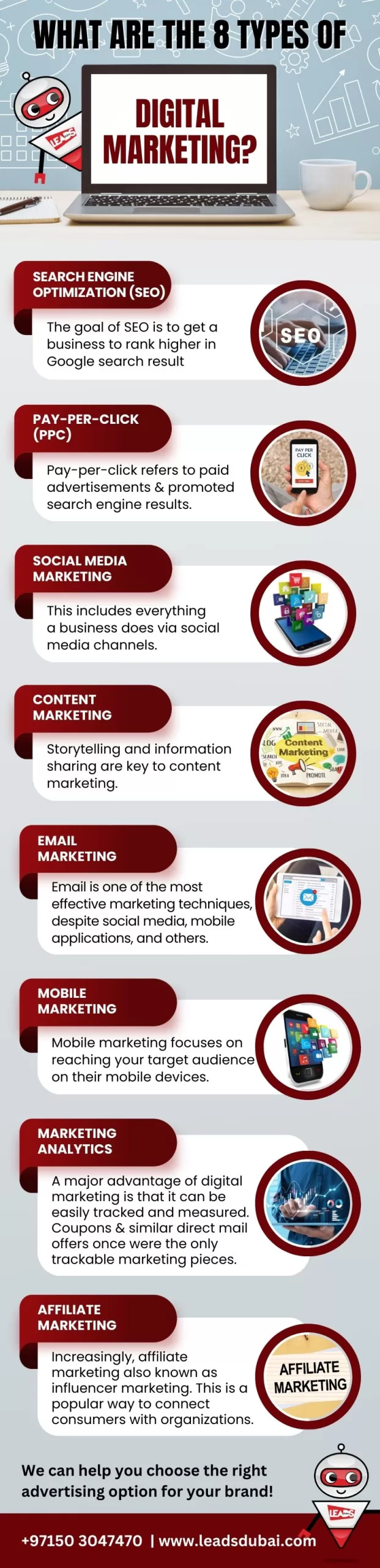
A strong strategy combines several channels working together:
- Search engine optimization (SEO): organic visibility on Google through technical work, quality content, and backlinks. Essential for sustainable traffic.
- Pay-per-click (PPC): paid ads on Google and beyond to capture high-intent traffic instantly, including search, display, shopping, and YouTube.
- Social media marketing: brand, community, and engagement on Instagram, Facebook, LinkedIn, TikTok, Snapchat, and X, all strong in the UAE.
- Content marketing: blogs, videos, podcasts, and infographics that attract and educate while building authority.
- Email marketing: nurturing and retention through personalised campaigns and automation. Still one of the highest-ROI channels.
- Affiliate marketing: partnering with publishers and creators who earn a commission for the sales or leads they drive.
- Influencer marketing: collaborating with creators to reach their engaged audiences, particularly effective in the UAE.
- Mobile marketing: SMS, WhatsApp Business, push notifications, and in-app campaigns for a mobile-first population.
The right mix depends on your model, audience, budget, and goals. Most successful Dubai brands run four to six of these together.
The 7 Cs of digital marketing
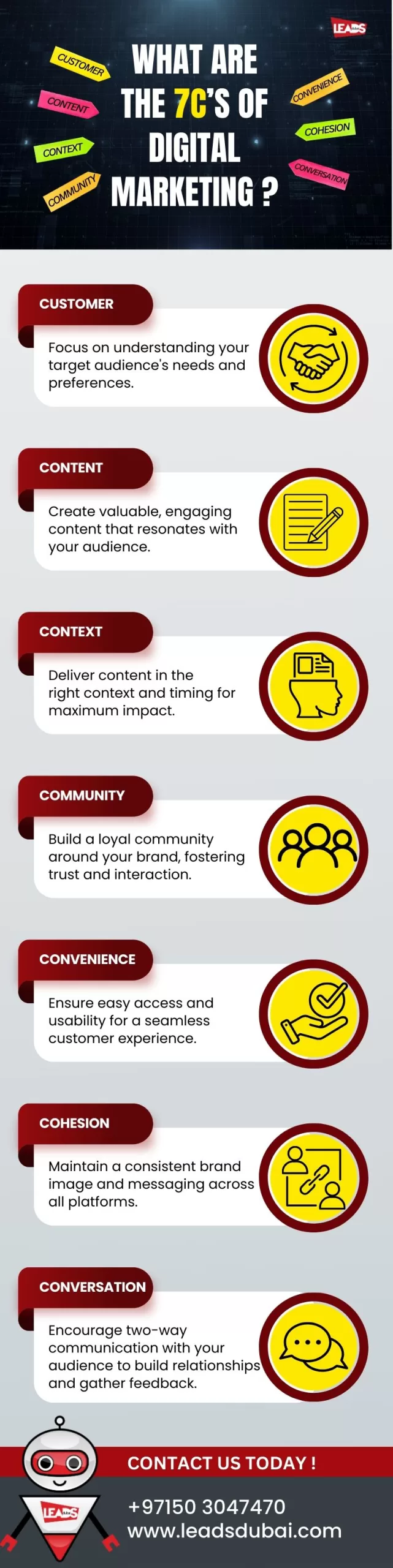
A strategic foundation for campaigns that resonate:
- Customer: deep understanding of needs, behaviour, and pain points.
- Content: valuable, relevant content that addresses those needs.
- Context: the right message, time, format, and channel.
- Community: genuine relationships and engagement around your brand.
- Convenience: making it easy to find, evaluate, and buy.
- Cohesion: a consistent brand experience across every touchpoint.
- Conversion: optimising every interaction toward becoming a customer.
This keeps your marketing strategically aligned with what customers actually want, not just tactically busy.
The 5 stages of digital marketing maturity
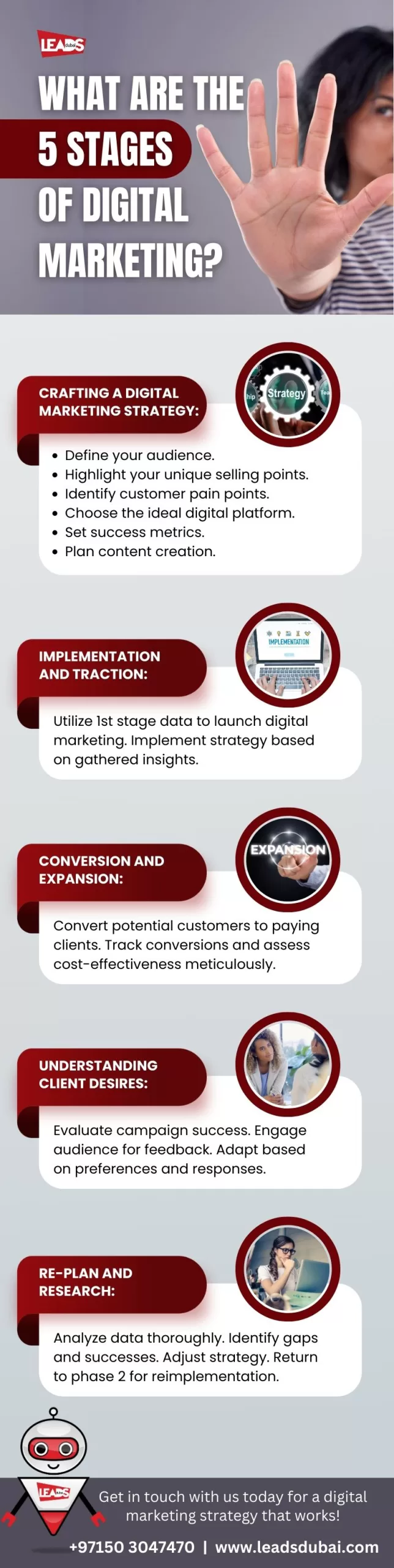
Knowing where you sit helps identify the right next step:
- Stage 1, Foundational: basic website, occasional posts, no clear strategy.
- Stage 2, Tactical: running campaigns, but in silos without integration.
- Stage 3, Strategic: documented strategy, KPIs tied to business goals, multi-channel coordination.
- Stage 4, Data-driven: advanced analytics, attribution, A/B testing, continuous optimisation.
- Stage 5, Predictive: AI personalisation, predictive analytics, real-time decisions at scale.
Most Dubai SMBs are at stages 2 to 3. The goal is to build capabilities that match your stage, not to leap ahead.
Why your marketing strategy is not working (and how to fix it)
If your marketing is not delivering, you are not alone. The usual reasons:
- No clear, measurable goals tied to business outcomes (just vanity metrics).
- Trying to be everywhere instead of where your audience actually is.
- Inconsistent execution: sporadic posting, abandoned tactics.
- Poor targeting that wastes budget.
- Weak, generic content that does not differentiate you.
- Treating campaigns as “set and forget” with no testing.
- Marketing, sales, and service operating in silos.
- Underinvestment in measurement, so you cannot tell what works.
- Ignoring the mobile experience even when most enquiries begin on a phone.
The fix is a strategic audit. Define what success looks like, find where you fall short, and prioritise the two or three highest-impact changes for the next 90 days. Sustainable improvement comes from disciplined execution, not chasing the latest shiny tactic.
A focused 90-day digital marketing plan
| Period | Work | Evidence to review |
|---|---|---|
| Days 1 to 30 | Fix tracking, define qualified leads, review offers and remove obvious landing-page friction | CRM match rate, form completion and lead quality |
| Days 31 to 60 | Improve one high-intent organic page and test one paid campaign | Search visibility, qualified leads and cost per acquisition |
| Days 61 to 90 | Add follow-up, compare channel contribution and move budget | Sales, revenue, assisted conversions and customer value |
Keep the plan narrow enough to learn. A business running six unfinished campaigns usually gets less useful evidence than one running two properly measured ones.
What people are searching for
Search trends are a window into what your audience cares about. The themes shaping behaviour now:
- AI tools and automation for productivity
- Sustainable and ethical brands
- Hybrid work and remote solutions
- Health and wellness, including mental health
- Personal finance, crypto, and investing
- Experiential travel and local UAE and GCC destinations
- Voice and conversational queries (longer, natural phrasing)
- Visual search via Google Lens and Pinterest
- “Near me” local searches
- How-to content for skill-building
For Dubai businesses, the move is to address these themes through a local lens, connecting global trends to UAE-specific needs.
Top digital marketing stories shaping the industry
Several developments are reshaping how UAE marketers work:
- Google’s continued AI integration across Search, Ads, and Analytics.
- Meta’s pivot to AI-driven advertising and creator monetisation.
- TikTok’s growing dominance in the UAE, especially with younger audiences.
- Generative AI tools transforming content and customer service.
- Apple’s privacy changes continuing to disrupt attribution.
- LinkedIn’s evolution into a content-first B2B platform.
- WhatsApp Business as a primary customer and commerce channel in the UAE.
- Retail media networks (Amazon, Noon, Carrefour) as ad platforms.
- Streaming and connected TV (CTV) advertising opening up.
Staying informed lets you anticipate change rather than react to it. Conferences like GITEX and Step are worth following.
The future of marketing
Looking 3 to 5 years out, the megatrends:
- AI as a co-pilot for research, content, optimisation, and analysis.
- Hyper-personalisation at scale, tailored to each customer.
- Privacy-first measurement using first-party data and clean rooms.
- Conversational commerce replacing traditional funnels in many categories.
- Creator-economy maturation, with long-term niche partnerships.
- Immersive experiences via AR, VR, and spatial computing.
- Community-led growth replacing one-way broadcast.
Dubai’s position as a global hub, plus the UAE’s tech-forward policies and digitally savvy population, puts local businesses in a strong spot to lead, if they invest now.
How the advertising agency model is changing
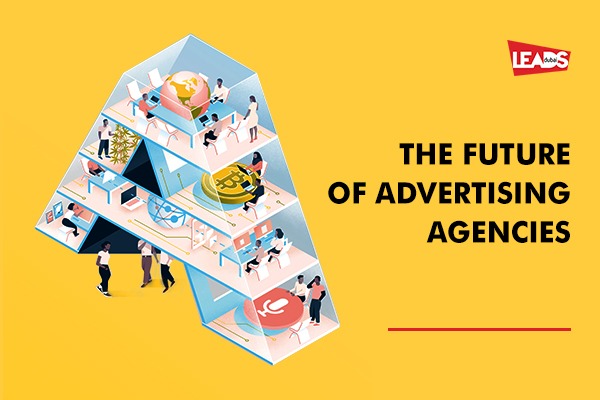
Advertising agencies are becoming smaller, more specialised and more accountable for commercial results. Some brands are building in-house teams while hiring specialists for paid media, SEO, creative production, analytics or automation. AI can shorten research, production and reporting work, but it does not replace market knowledge, judgement or responsibility for the campaign.
The practical distinction is no longer simply between a large full-service agency and a small agency. Businesses can choose an integrated partner that manages strategy across channels, or assemble several specialists around an internal marketing lead. The right structure depends on the budget, the number of markets and how quickly the business can review and approve work.
When choosing an agency, ask who will work on the account, what is included, which work is outsourced, how often results are reviewed and what happens when performance falls below plan. Relevant case studies and transparent reporting are stronger evidence than a long service list. See our guide to choosing an advertising agency in Dubai for the service-level questions to ask before signing.
Putting it together
The fundamentals are straightforward: understand the customer, give each channel a clear role, keep the offer consistent and measure what matters. Fix tracking and conversion problems before adding more campaigns.
Leads Dubai has helped over 500 companies grow since 2013. If you want a strategy built on these principles, see our digital marketing services or call +971 50 304 7470.
Digital marketing strategy questions
The main types are SEO, paid search, social media, content, email, affiliate, influencer and mobile marketing. A business should select channels according to customer intent and measurement, rather than trying to use every channel at once.
The 7 Cs are customer, content, context, community, convenience, cohesion and conversion. They provide a practical way to check whether a marketing plan is relevant, consistent and easy for the customer to act on.
Common causes include unclear goals, weak targeting, inconsistent execution, poor measurement and spreading the budget across too many channels. Audit the customer journey, choose the few changes most likely to affect qualified leads or sales, and review them over a defined period.
Agencies are becoming more specialised and more accountable for business outcomes. Brands increasingly combine internal teams with external specialists for paid media, SEO, creative, analytics and automation.
Ask who will manage the account, what is included, which work is outsourced, how reporting works and how the agency responds when results fall below plan. Relevant evidence and a clear process are more useful than promises of guaranteed results.