 Training guide
The Role of Artificial Intelligence in Digital Marketing
Where AI genuinely changes digital marketing, from targeting and creative to analysis, what it does not do well yet, and the line Google draws on AI content.
In short: AI changes digital marketing most in targeting, creative production and analysis. It drafts and varies content faster, finds patterns in campaign data, and now decides which pages get summarised in search results. What it does not do is supply judgement, first-hand experience or a point of view, which is what still separates content that ranks from content that does not.
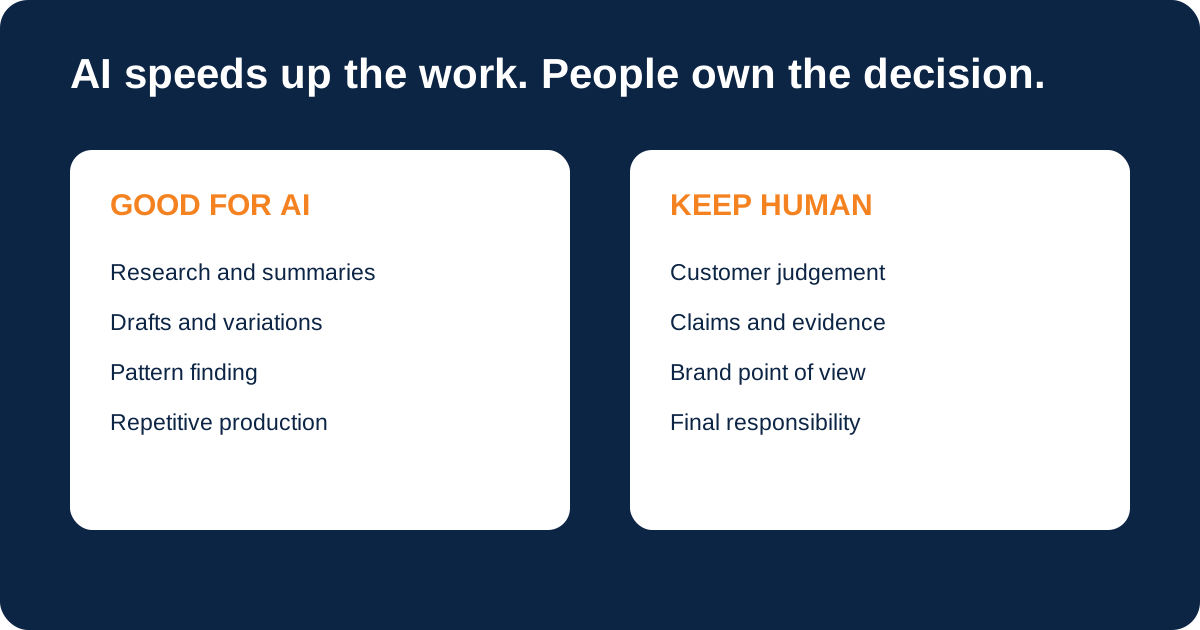
AI in digital marketing is most useful for work that involves many signals or many variations: setting bids, matching audiences, drafting creative options, finding patterns in campaign data and answering routine customer questions. It can speed up production and analysis. It cannot decide what your business should promise, whether a lead is good, or whether a claim is true. Those decisions still need a person who understands the customer and owns the result.
Where marketers already use AI
Advertising and bidding
Google Ads uses machine learning in Smart Bidding to set a bid for each auction based on the campaign goal and available signals. Performance Max also uses AI to combine assets, choose inventory and optimise toward the conversion goals supplied by the advertiser. This can save manual work, but the system will pursue the goals it is given. If a weak enquiry and a qualified sale are recorded as equal conversions, automation learns the wrong lesson faster.
Primary sources: Google’s Smart Bidding guide and Performance Max explanation.
Creative production
Generative tools can turn a brief into headline options, image concepts, short-video variations and translations. That is useful for exploration and testing. The final material still needs a factual review, brand check, rights check and a person asking whether it sounds like something the company would actually say. Producing twenty versions is not useful if none of them contains a reason to choose the offer.
Research and analysis
AI can group search terms, summarise customer comments, identify repeated questions and help an analyst explore a large report. Treat the output as a lead, not as evidence. Check the original rows, calls, search terms or source documents before changing a campaign. Summaries can hide an important minority or confidently join facts that do not belong together.
Customer support and follow-up
A chatbot can answer routine questions, collect basic details and route a conversation. It should say when the answer is automated, avoid inventing policy or pricing, and hand the conversation to a person when the question affects money, eligibility or a complaint. A quick wrong answer is worse than a slower accurate one.
What should remain under human control
- The objective. A platform can optimise a number, but somebody must decide whether that number represents a useful business result.
- The offer and claim. AI does not know whether a price, guarantee, credential or customer story is authorised and true.
- Customer suitability. A low-cost lead is not valuable if the sales team cannot serve that person.
- Source verification. Important facts should be checked against the original source rather than another generated summary.
- Publication. A named person should approve work that represents the business publicly.
A practical way to introduce AI into a marketing team
- Pick one repetitive task. Start with reporting notes, creative variations or classifying enquiries, not the whole marketing operation.
- Save a baseline. Record the time, error rate and business result before using the tool.
- Define what the tool may use. Do not paste confidential customer or company data into a system without an approved data policy.
- Require a review. Name the person checking facts, tone, permissions and the final decision.
- Test against the old process. Compare quality and outcomes, not just how quickly the first draft appeared.
- Keep an exit route. A campaign or workflow should still be understandable if the tool, model or vendor changes.
AI content and search visibility
Google does not prohibit content merely because AI helped create it. Its published guidance focuses on accuracy, quality, relevance and whether pages add value for users. Generating many pages mainly to manipulate rankings can fall under scaled content abuse. A useful process starts with a real audience question, adds first-hand knowledge or evidence, verifies claims and gives publication responsibility to a named person.
Read Google Search Central’s current guidance on generative AI content and visibility in AI search features.
What an AI-aware marketer needs to learn
Prompt writing is a small part of the job. The durable skills are defining the commercial goal, reading campaign data, checking sources, writing a usable brief, understanding consent and measurement, and spotting when automation is chasing the wrong outcome. Learn the marketing system first, then use AI to speed up parts of it.
Our digital marketing training in Dubai teaches the channel and measurement skills behind these decisions. Choose the Google Ads, SEO, social media, analytics, content or email course according to the work you need to perform.
FAQs
How is AI used in digital marketing day to day?
Common uses include automated bidding, audience modelling, creative variations, research organisation, search-term grouping, reporting summaries and routine support. The useful gain is speed on repeatable work, provided a person checks the input and result.
Will AI replace digital marketing jobs?
It will change the work and reduce some repetitive production tasks. People are still needed to choose goals, understand customers, judge lead quality, verify claims and take responsibility for decisions.
Does Google penalise AI-generated content?
Not simply because AI was used. Google says content should be accurate, relevant and useful. Producing many low-value pages mainly to manipulate search rankings can violate its scaled content abuse policy.
Can AI run advertising campaigns by itself?
It can automate bidding, matching and creative combinations, but it still needs accurate conversion tracking, suitable goals, useful source material, budget controls and human review of lead quality.