

Most businesses do not have a lead problem. They have a lead quality problem.
You can fill your pipeline with form submissions and still close very few deals, because volume and quality are not the same thing. Qualified lead generation is about closing that gap: attracting people who are genuinely likely to buy, and training your campaigns to chase them instead of the cheapest click.
Here is a practical, no-fluff guide to doing exactly that.
Key takeaways
- Stop measuring success at the form fill. Track what happens after it is qualified, converted, and sold.
- Map your full lead-to-sale journey and pick one conversion action with the right mix of quality, volume and speed.
- Import your offline and CRM data so Google can optimise toward real revenue, not cheap leads.
- Tell the system which leads are worth more using real values, proxy values, or predictive values.
- Add qualifying questions to your lead forms to filter time-wasters before they reach your sales team.
What qualified lead generation actually means
A qualified lead is not just a form fill. It is a lead that shows real intent and a genuine chance of becoming revenue.
Depending on your business, a qualified lead might be one that meets a minimum budget or fit, has been accepted by your sales team, reached a deeper stage in the funnel, or ended in a closed sale. The point is simple: not every submission deserves the same attention or budget.
Why most campaigns chase the wrong leads
The path from ad click to sale is rarely a straight line. A prospect searches, compares options, submits a form, speaks to a sales rep days later, and closes weeks after that — often offline.
If your ad platform only ever sees that first form fill, it will optimise for cheap leads. Your cost per lead looks great on the dashboard while sales quality quietly drops. This is most common in B2B, real estate, education, finance, insurance and home services — anything with a long sales cycle or an offline closing process.
Step 1: Map your lead-to-sale journey
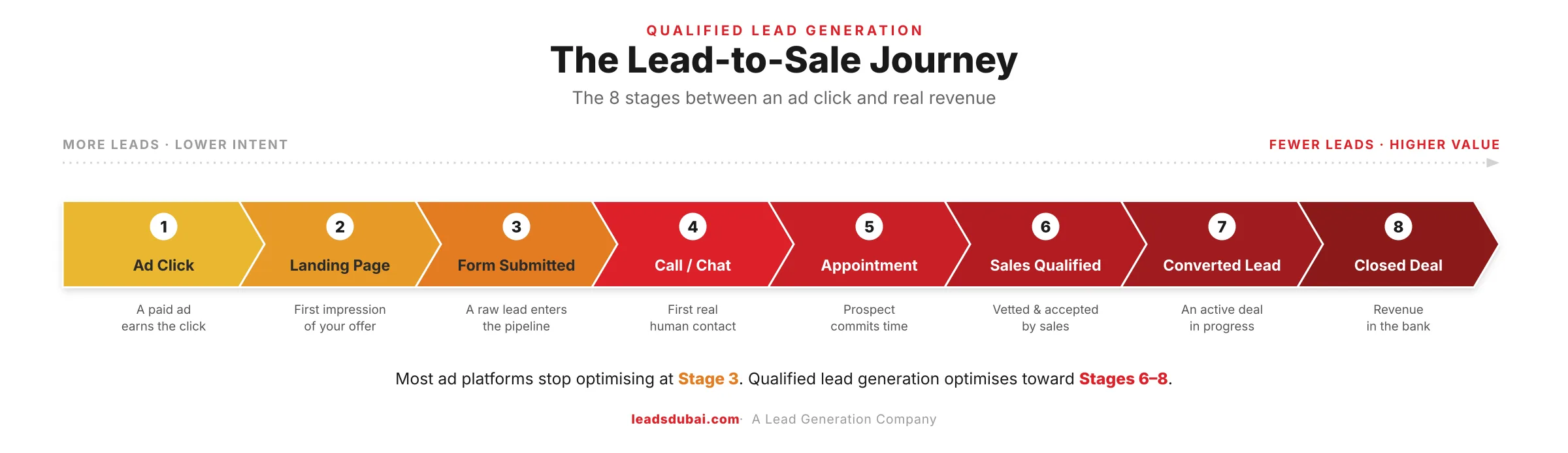
Write down every meaningful stage between the first ad click and the final sale. A typical journey looks like this:
Ad click → landing page visit → form submission → call or whatsapp chat → appointment booked → sales qualification → converted lead → closed deal.
Then answer three questions:
- Which of these stages actually predicts revenue?
- Which ones can you measure reliably?
- Which one gives you enough volume, fast enough, to optimise toward?
Step 2: Pick one conversion action that signals quality
Not every business can optimise straight to closed sales — some happen too rarely or too late for the system to learn from. The best conversion action usually hits a “sweet spot”:
- Enough volume to train automation.
- A short enough delay after the click.
- A clear link to real business outcomes.
If you can measure the final sale with a value attached, that is the strongest signal. If it is too slow or sparse, pick a strong mid-funnel predictor instead — a demo booked for B2B software, an application started for education, or a qualified inquiry with product details for automotive or insurance.
Step 3: Feed Google your offline data
In most lead gen accounts, the conversions that matter most happen after the form fill — inside your CRM, your call centre, or a sales conversation. If that data never goes back into your ad account, your optimisation is running half-blind.
Fix it by importing offline conversions such as qualified lead, converted lead and closed-won deal. Adding enhanced conversions for leads improves how well those later events match back to the original click. Upload this data consistently and frequently — not as a delayed manual export once a month.
Step 4: Tell the system which leads are worth more
If every lead is treated as equal, your bidding has nothing useful to learn from. Give it variation:
- Pass real values when you can, and use value-based bidding (target ROAS) to prioritise quality over raw count.
- Use proxy values when you cannot — for example, company size for B2B, vehicle model for automotive, or program type for education.
- Use predictive values based on historical outcomes when lower-funnel results are delayed.
If you cannot pass value at all, conversion-based bidding (target CPA) still works well — as long as the conversion action itself represents a quality event.
Step 5: Filter leads at the form
One of the fastest quality wins is adding qualifying questions directly to your lead forms. For example: Which product or service are you interested in? How soon do you plan to buy? What is your budget or company size?
These questions filter out casual submissions and give your sales team context before the first call. And remember — a weak landing page can undo all of this. If the page does not build trust, even great campaigns will bring poor leads.
Mistakes that quietly kill lead quality
- Optimising to raw leads only — you get volume without quality.
- Ignoring offline outcomes — the best data stays trapped in your CRM.
- Choosing a conversion event that is too delayed — automation cannot learn from it.
- Using flat values for every lead — value-based bidding has nothing to work with.
- Poor conversion labelling — mixing shallow and deep events under one category.
- Thin creative — only basic text assets, missing visual placements.
- Inconsistent data uploads — delayed imports make optimisation slow to react.
Your quick-start checklist
- Map your full lead-to-sale journey.
- Choose the conversion action with the best balance of quality, volume and speed.
- Track both online and offline touchpoints.
- Import CRM outcomes consistently.
- Separate lead submit, qualified lead, converted lead and purchase as distinct actions.
- Pass real values, or use proxy or predictive values.
- Add qualifying questions to your lead forms.
- Judge campaigns on downstream quality — not cost per lead alone.
Frequently asked questions
What is the difference between lead generation and qualified lead generation?
Lead generation focuses on collecting leads. Qualified lead generation focuses on attracting and identifying leads that are far more likely to become paying customers.
What if I cannot track final sales in Google Ads?
Optimise toward a lower-funnel action that predicts sales, such as qualified lead or converted lead. You can also use proxy or predictive values when direct revenue data is not available.
What is the best conversion action for lead gen?
Usually the deepest funnel event you can measure reliably, with enough volume and an acceptable delay. The exact answer depends on your business model.
Do lead form questions reduce lead volume?
They may reduce raw volume slightly, but they improve quality — and quality is what fills your sales pipeline with real opportunities.
Get qualified leads with Leads Dubai
Qualified lead generation comes down to one shift: stop measuring success at the form fill. Once your campaigns can see which leads become qualified, converted and sold, your whole optimisation strategy gets sharper.
That is what we do. Leads Dubai is a Google Partner and a dedicated lead generation company in Dubai — since 2013 we have helped over 500 businesses across the UAE turn ad spend into real customers. We can audit your Google Ads setup, fix your conversion tracking, and build campaigns that chase quality, not just clicks.
Call +971 50 304 7470 or contact Leads Dubai for a free review of your lead generation setup.